


Have you ever noticed how some marketing pieces seem to disappear the moment you look at them?
The design might be polished. The photos are professional. Everything is printed beautifully. Yet nothing about it makes you want to do anything next.
Then you come across another postcard, brochure, or sign that stops you just long enough to think, Maybe I should look into that.
The difference often isn’t the paper or the printing. It’s the message.
Good marketing doesn’t simply announce information. It gives people a reason to care.
Saying More Isn’t the Same as Saying Something Better
Businesses often assume that if customers understand what they’re offering, they’ll naturally take the next step. That’s why so many marketing pieces focus on listing products, services, or features.
The problem is that customers rarely begin by asking, “What do they sell?”
They’re asking questions like:
- How does this help me?
- Why should I pay attention now?
- Is this worth my time?
The strongest headlines answer those questions before customers even realize they’re asking them.
Take a simple seasonal promotion.
A headline like “Fall Sale – 20% Off Storewide” tells people what’s happening.
A headline like “Before the Leaves Fall, Save on the Season’s Favorites” gives the promotion context. It creates a picture in the reader’s mind and makes the offer feel timely instead of routine.
Both communicate the same discount. One simply gives people a better reason to notice it.
Small Changes Can Completely Change the Message
Sometimes the most effective improvement is surprisingly small.
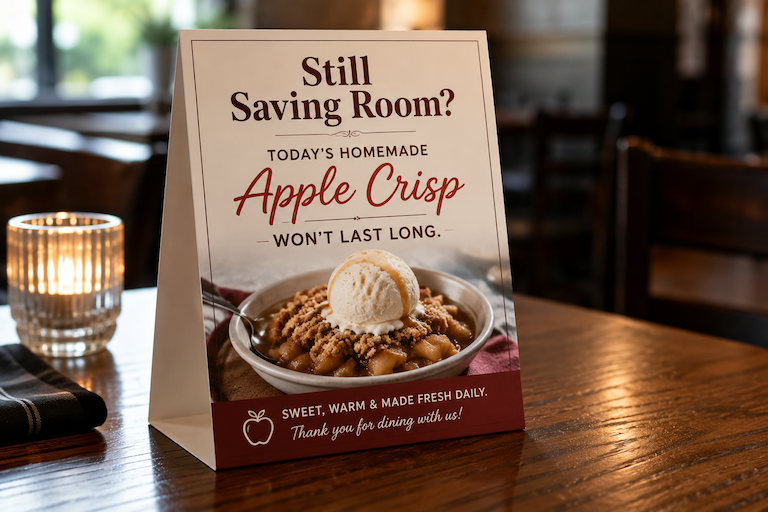
Think about a table tent in a restaurant promoting dessert.
“Ask About Dessert” isn’t wrong. It’s simply incomplete. It puts all the work on the customer.
Now compare it to:
Still Saving Room? Today’s Homemade Apple Crisp Won’t Last Long.
Nothing dramatic has changed. The table tent still promotes dessert. But now it sparks curiosity, paints a picture, and gives diners a reason to ask a question they might not have asked otherwise.
The same principle applies almost everywhere print appears.
A landscaping brochure doesn’t become more persuasive because it lists additional services. It becomes more persuasive when it shifts the conversation from what the company does to what the customer gains.
Instead of saying:
We provide complete residential landscaping services.
Consider:
Spend Less Time Working in Your Yard. Spend More Time Enjoying It.
People don’t buy landscaping because they want another company to mow their lawn. They buy back their Saturday morning.
Every Call to Action Should Answer “Why?”
One of the weakest phrases in marketing might also be one of the most common.
Scan Here.
There’s nothing technically wrong with it, but it leaves out the one thing people actually want to know.
Why should I?
Adding just a few words often makes a remarkable difference. Instead of asking someone to scan a code, invite them to:
- Scan for this month’s specials.
- Scan to see the full menu.
- Scan for the five-minute buyer’s guide.
- Scan to claim your free estimate.
The action hasn’t changed. The motivation has.
Think Like Your Customer, Not Your Company
One exercise can improve almost any printed piece before it goes to press. Read your headline and imagine you’re seeing it for the very first time.
- Would it make you curious?
- Would it answer a question?
- Would it promise something useful?
Or is it simply announcing information that matters more to your business than it does to your customer?
That small shift in perspective often leads to stronger headlines, clearer calls to action, and marketing pieces that earn attention instead of hoping for it.
Influence Begins With Better Words
Design catches the eye, but words shape the decision.
Whether you’re creating a postcard, brochure, banner, direct mail piece, table tent, or counter display, the goal isn’t simply to tell people what’s happening. It’s to help them understand why it matters.
If you’re looking for ways to make your next print project more persuasive, let us know. We can help you combine thoughtful messaging with high-quality print so every piece has a better chance of being read, remembered, and acted on.